
Most golf simulator practice sessions go the same way. You book an hour, hit driver for forty minutes because driver is fun, play two holes of Pebble Beach, and leave with a sore back and no idea whether you got better. We have watched it happen in all six of our bays, and we have done it ourselves.
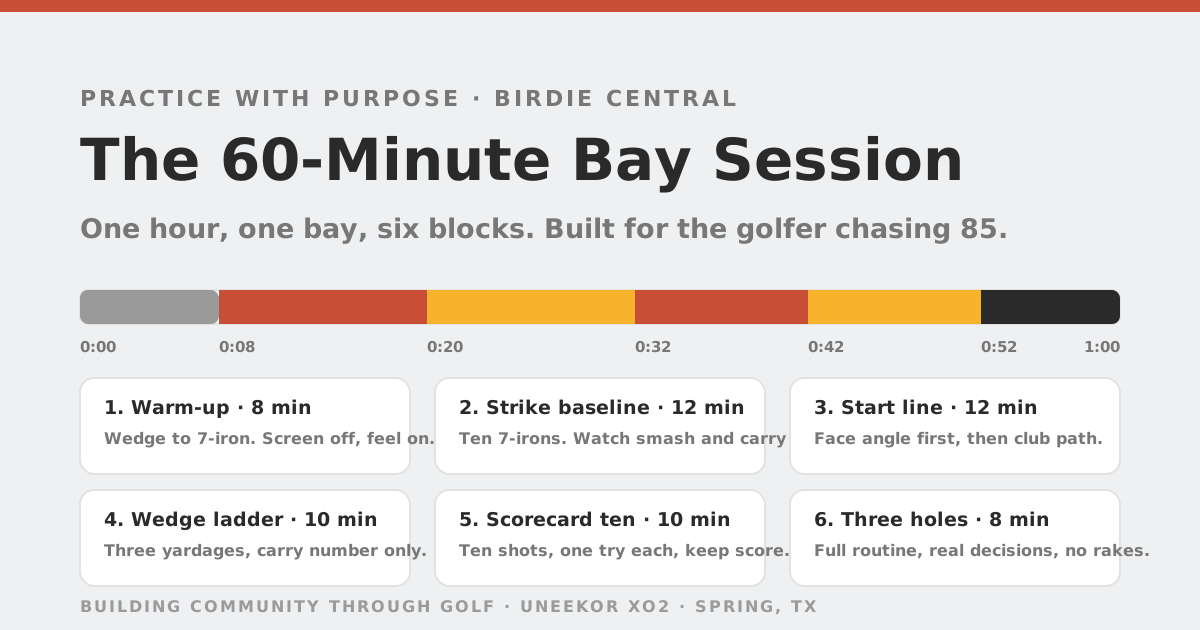
The fix is not more effort. It is structure. A launch monitor gives you a number for every swing, and the drills below are built to use those numbers rather than admire them. This is one 60-minute plan, five core drills plus two swap-ins, written for the golfer who shoots in the 90s and wants to see 85. Follow the clock, and compare this week to last week.
Why golf simulator practice drills work differently
On a driving range you get one piece of feedback: where the ball ended up, roughly. On a simulator you get where it ended up plus why. Each of our bays runs a Uneekor XO2, an overhead camera launch monitor that reads both the ball and the club at impact, so every shot comes back with carry distance, ball speed, launch angle, spin, club path, face angle, attack angle and where on the face you struck it.
That changes what a drill can be. A range drill asks you to hit ten balls at a flag and count how many finished close. A simulator drill can ask you to get your face angle within two degrees of square on eight of ten, which is a thing you can actually train.
If the data is new to you, read our guide to golf simulator data explained first. The plan below assumes you know what club path and face angle mean.
The 60-minute session, block by block
Block 1: Warm-up, 8 minutes, screen ignored
Start with a wedge and work up to a 7-iron, maybe fifteen balls total, at half to three-quarter speed. Do not look at the numbers. Warm-up swings are stiff and slow and they will put junk in your session data if you let them count. Your smart lock PIN arrives fifteen minutes before your booking, so you can be swinging by minute one.
Block 2: The strike baseline, 12 minutes
This is the drill that anchors everything else. Take your 7-iron and hit ten shots at one target with your normal full swing. Do not try anything. Then look at three things:
- Carry distance spread. Not your best 7-iron, your range of 7-irons. A golfer shooting in the 90s often sees a 25 to 30 yard gap between the longest and shortest carry in ten balls. Shrinking that spread does more for your scores than adding ten yards to the longest one.
- Smash factor. Ball speed divided by club speed. With an iron, mid 1.30s is solid contact, low 1.20s is a strike off the toe or heel. If your smash number jumps around, your strike is jumping around, and that is the thing to fix before anything else.
- Impact location. The XO2 shows where on the face you hit it. Ten dots scattered across the face explain a scattered carry number better than any swing theory.
Write down the carry spread and the average smash. That is your baseline. Every session starts with this same ten-ball check, and the two numbers should tighten over the weeks. Our piece on understanding your launch monitor numbers goes deeper on what good looks like for each of them.
Block 3: Start line, 12 minutes
Where the ball starts is mostly face angle. Where it curves is mostly the difference between face and path. Most golfers fix the wrong one, so this block separates them.
Part one, face only, 6 minutes. Pick a target and hit 7-irons with one goal: a face angle reading between two degrees closed and two degrees open. Ignore the curve, ignore the distance. If you are consistently open, feel the face closing earlier through impact and watch the number respond. This is the fastest feedback loop in golf, and it is only possible with a club-reading launch monitor.
Part two, path, 6 minutes. Now hold the face where you got it and look at club path. If your path reads four or five degrees out to in with a square face, you are hitting a pull-fade, the most common miss we see in the bays. Bring path to within two degrees of zero and the shot straightens out on the screen.
Do not try to fix face and path at the same time. One number, then the other.
Block 4: The wedge ladder, 10 minutes
Scoring for a 90s golfer happens between 40 and 100 yards, and it happens on carry distance. Pick three yardages, say 50, 70 and 90, and hit three balls to each with your most lofted wedge, changing the length of your backswing rather than the speed. Track carry only. Total distance on a screen does not tell you much about a wedge.
The goal is not to hit 70 exactly. It is to hit 70 three times within five yards of each other. When the three balls at a yardage land together, you own that number. Write the carries down, and in two months you will have a personal wedge chart the range could never give you, because the range never told you the carry.
Block 5: The scorecard ten, 10 minutes
Practice is only useful if it survives pressure, so this block adds some. Set up ten shots at ten different targets and distances, and you get one attempt at each. No mulligans, no reloads. Score each one: three points inside 15 feet, two inside 30, one inside 50, zero for anything else. A perfect session is 30.
Play this the same way every week and the score becomes the best single measure of whether your practice is working. Two friends in one bay running the scorecard ten is one of the better Tuesday nights available in Spring.
Block 6: Three holes, 8 minutes
Finish on the course. Load any course, play three holes, and use your full pre-shot routine on every shot: stand behind the ball, pick a specific target, one practice swing, commit. This is where the drill work gets tied back to actual golf. If the hour is running long, play one hole. Do not skip it.
Two swap-in drills for when the baseline is stable
Once your strike baseline stops moving week to week, trade Block 3 or Block 4 for one of these.
Swap-in A: The gapping check
Hit five balls with every club in the bag, lob wedge up to driver, and look only at average carry. What you want is a steady step between clubs, roughly 10 to 15 yards through the irons. What you often find is two clubs that fly the same distance, or a 25 yard hole between your longest iron and your fairway wood. Both cost strokes and neither is a swing problem. This one takes a full hour on its own, so plan it as its own session every couple of months.
Swap-in B: The shape drill
Take a 7-iron and hit three intentional fades, three intentional draws, then three straight. On the XO2 you can see whether your fade is actually a fade, meaning a face slightly open to a path that is even more left, or whether you just aimed left and hit your normal shot. Most golfers cannot curve it both ways on demand, and that is fine. The value is learning what face and path do when you try, which is the same knowledge that fixes your miss.
If you have been doing versions of the same random session for months, book a single hour, run this plan once, and see how different the drive home feels.
How to make it stick
- Keep a note on your phone. Four lines per session: carry spread, average smash, wedge carries, scorecard ten total. That is your whole progress log.
- Change one thing per session. If the baseline says the face is the problem, the whole hour is about the face. Chasing three fixes at once is how you fix none.
- Twice a week beats once for four hours. Two one-hour sessions with a rest day between them let a change settle in. The 24/7 access here exists for exactly this; a Tuesday 6 AM and a Thursday 9 PM is a perfectly good week. Our post on practicing on your own schedule covers what those hours look like.
- Take the numbers to the course, not the feels. A wedge chart and a known carry spread are useful at Gleannloch on Saturday. A swing thought from Wednesday is usually gone by the third tee. The sim is the partner that does the homework.
- Get a second pair of eyes once in a while. The numbers tell you what is happening. A lesson, or a session with our AI swing trainer during staffed hours, is faster at telling you why.
What to skip on a simulator
Bunker shots do not exist here. Putting on a simulator is a different skill from putting on grass, so spend those minutes on wedges instead. And a mat lie is always perfect, which flatters a slightly fat strike. If your carry numbers in the bay run five yards past what you see on the course, that is normal, and one more reason to practice the carry spread rather than the peak number.
None of that is an argument against the sim. It is an argument for using it on what it measures better than anywhere else, which is everything from 40 yards out to the tee box. Our golf simulator vs driving range comparison makes the same case with more numbers.
Frequently asked questions
How long should a golf simulator practice session be?
One hour, for most people. Long enough to warm up, run three or four focused drills and play a few holes, short enough that the last twenty balls still count. Two hours of solo full swings is usually an hour of practice followed by an hour of tired swings.
Which launch monitor numbers matter most?
Three to start: carry distance, face angle and club path. Carry tells you whether the strike was solid and gives you real yardages. Face explains where the ball started, and the difference between face and path explains why it curved. Smash factor is a good fourth for strike quality. Spin and launch matter more once those are steady.
How often do I need to practice to see improvement?
Two one-hour sessions a week, repeating the same drills, shows up in the numbers within about a month for most golfers. Once a week holds what you have. What matters is repeating the same measured drills so that this week can be compared to last week.
What does an hour cost?
An open bay is $25 an hour Monday to Thursday before 4 PM and after 10 PM, $35 on weekday evenings, and $45 Friday through Sunday. Private bays are $35, $45 and $55 for the same windows. It is per bay, not per person, and loaner clubs are included. Full detail is on the play and pricing page, and if you are running this plan twice a week, a membership costs less than paying hourly.
Run it this week
Warm up, take a ten-ball baseline, fix one number, own three wedge yardages, keep score under pressure, play three holes, write four lines down. Do that twice a week for a month and 85 will be a lot closer than it looks from here.
We are at 19059 Champion Forest Dr in Spring, two minutes from Gleannloch, open around the clock once you have done the two-minute setup. Book an hour, bring this page, and start the clock. Building community through golf, one measured swing at a time.